UI Unbiased Insights Download the Book

You did everything the startup playbook told you to. So why isn't it working?

Most founders are building from a perspective they were never told they had: solution-first. But if you start from the outcome the customer already wants instead, and the same goals, the same frameworks, the same daily work don't just improve. They reorder. Half of what looked like a new problem turns out to be the same problem, seen from the other side.

11
Chapters
4
Parts
3
Frameworks
1
Perspective
The Winning Startup Perspective, by Tom Collopy
⌄
"The typical founder sells the plane (solution). The experienced founder sells the beach (outcome). Nobody likes flying in the plane (solution), they tolerate it because they want the beach (outcome)."

Tom Collopy, The Winning Startup Perspective

This book is that reorder: the shift from selling the plane to selling the beach.

The Core Contrast

Read down the left column and every sentence starts with "I" and centers on the product. Read down the right column and every sentence starts with the customer and centers on the outcome.

Product-First ThinkingOutcome-First Thinking
I see a problem.Customers already want an outcome.
I have a solution.Something is blocking that outcome.
I need to demo it.I need to understand the outcome they want.
I need people to try it.I need to create content that gets them to take that step.
I need to refine it.I need to learn what isn't working in that content.
I need leads.I need to get my refined content in front of more people.
I need to sell it.I need to keep tweaking that content until more people say yes.

You did the right things. They didn't work.

Marisol ran forty customer discovery interviews. Dev shipped constantly. Renu had fourteen paying customers. All three did the process right. All three were stuck.

Not for the reason they thought. Each one was running a sensible process from a single perspective, without knowing it was a perspective: solution-first, not outcome-first.

(These three are composites, built from weekly advising sessions, not one founder's story, but true to the room.)

"I did everything correctly. My real fear is that there's something obvious everyone else figured out and nobody told me."
Marisol
Six months in. 40 discovery interviews. MVP shipped. Accelerator graduate.
Nothing is converting. She suspects she's doing everything right and the idea is simply bad.
Dev
Senior engineer. Second product. Shipping constantly. Product is excellent.
Conversion never moved. Every piece of advice he gets is soft. He wants evidence, not stories.
Renu
Fourteen paying customers. Real revenue. Uses the word 'traction' in investor updates.
Thirteen of fourteen came from people who knew her. Strangers don't buy. It won't repeat.

You were never behind. You were never bad at this. You did real work, often a great deal of it, and you did it intelligently. You were simply running a sensible process from the only perspective anyone ever handed you — solution-first, product at the center, the customer's wanting assumed rather than examined. You heard problem and solution so many times, from so many sources, that no one ever thought to show you the other place to stand.

That missing perspective was the whole gap. Not your effort. Not your idea, necessarily. Not your persistence. Just the angle.

Two Ways to Build a Startup

Almost every founder draws the same plan, whether they write it down or not: see a real problem, build something that solves it, then put it in front of people so they can see how it solves the problem for them. Every step produces something to show, whether it's a demo, a pilot, or a new feature, so it feels like progress the whole way. Where it breaks is later: the thing gets genuinely good, and people still don't act, because "good" was never the question anyone tested. The plan assumes the wanting was already there, waiting on a good enough product to unlock it. Often it isn't.

Product-First
Problem → Solution → Demo → Sell

See the problem. Build the solution. Show it. Sell it.

Outcome-First
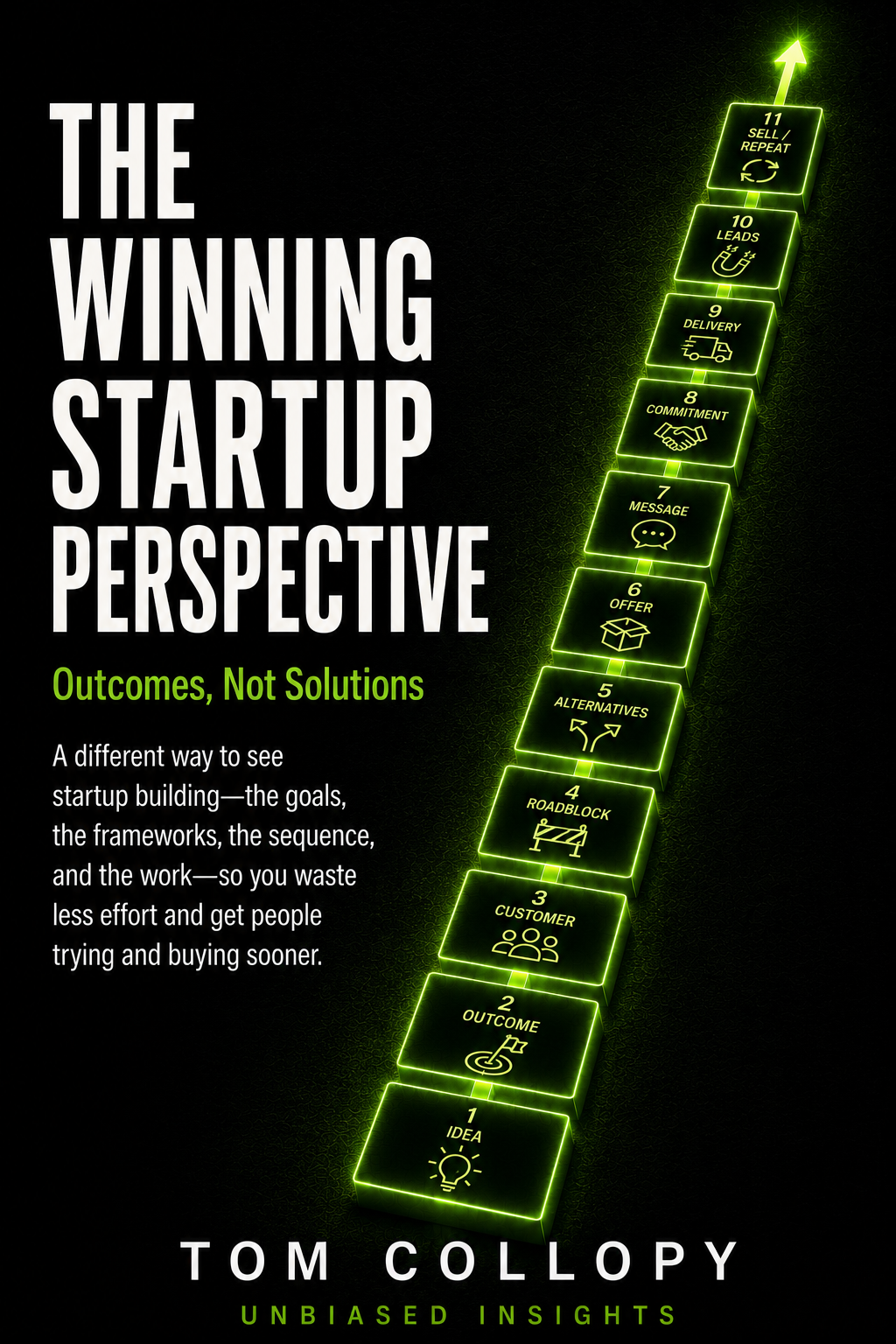
Outcome → Roadblock → Offer → Repeat

Find what they already want badly enough to act on. Find what's stopping them from reaching it. Build the smallest offer that clears the roadblock. Repeat with the next customer who wants the same thing.

The Winning Startup Perspective: Chapters

Download Full Book
introINTRODUCTION
Three Founders, One Wall
Three founders. Three completely different situations. The same wall.
Read →
01PART 1
The Beach
The outcome is the beach. The product is the plane. Nobody has ever wanted a flight.
Read →
02PART 1
Two Ways to Hear the Same Sentence
She did all the right things. The problem was the question underneath them got swapped.
Read →
03PART 1
The Product-First Spine
The plan almost every founder draws — without realizing they're drawing it.
Read →
04PART 2
The Outcome-First Spine
Same pieces. Different center. Everything reorganizes from here.
Read →
05PART 2
The Core Contrast
Product-first vs. outcome-first, line for line. The whole reorientation in two columns.
Read →
06PART 3
Frameworks Aren't Steps
Stop asking 'have I done this?' Start asking 'what question was this built to answer?'
Read →
07PART 3
The Learning Questions
Discovery, Lean, and the MVP — what they were built for vs. what founders do with them.
Read →
08PART 3
The Evidence Questions
Product-Market Fit and Traction are evidence labels. What matters is what they're labeling.
Read →
09PART 3
The Market and Money Questions
Value prop, business model, go-to-market — all questions about the outcome and what repeats.
Read →
10PART 4
The Discomfort Is the Point
The outcome-first questions are uncomfortable because they can reveal your story is weaker than you hoped.
Read →
11PART 4
The One Thing to Do
You don't need to work harder. You need to aim before you build.
Read →
concl.CONCLUSION
You Were Never Behind
You were running a sensible process from the only perspective anyone ever handed you.
Read →

Stop building around a story your customers don't share.

This book is free. Once you see the reorder, you can't unsee it.

Download The Winning Startup Perspective

More From Tom Collopy

My 11 Startup Rules, by Tom Collopy

My 11 Startup Rules

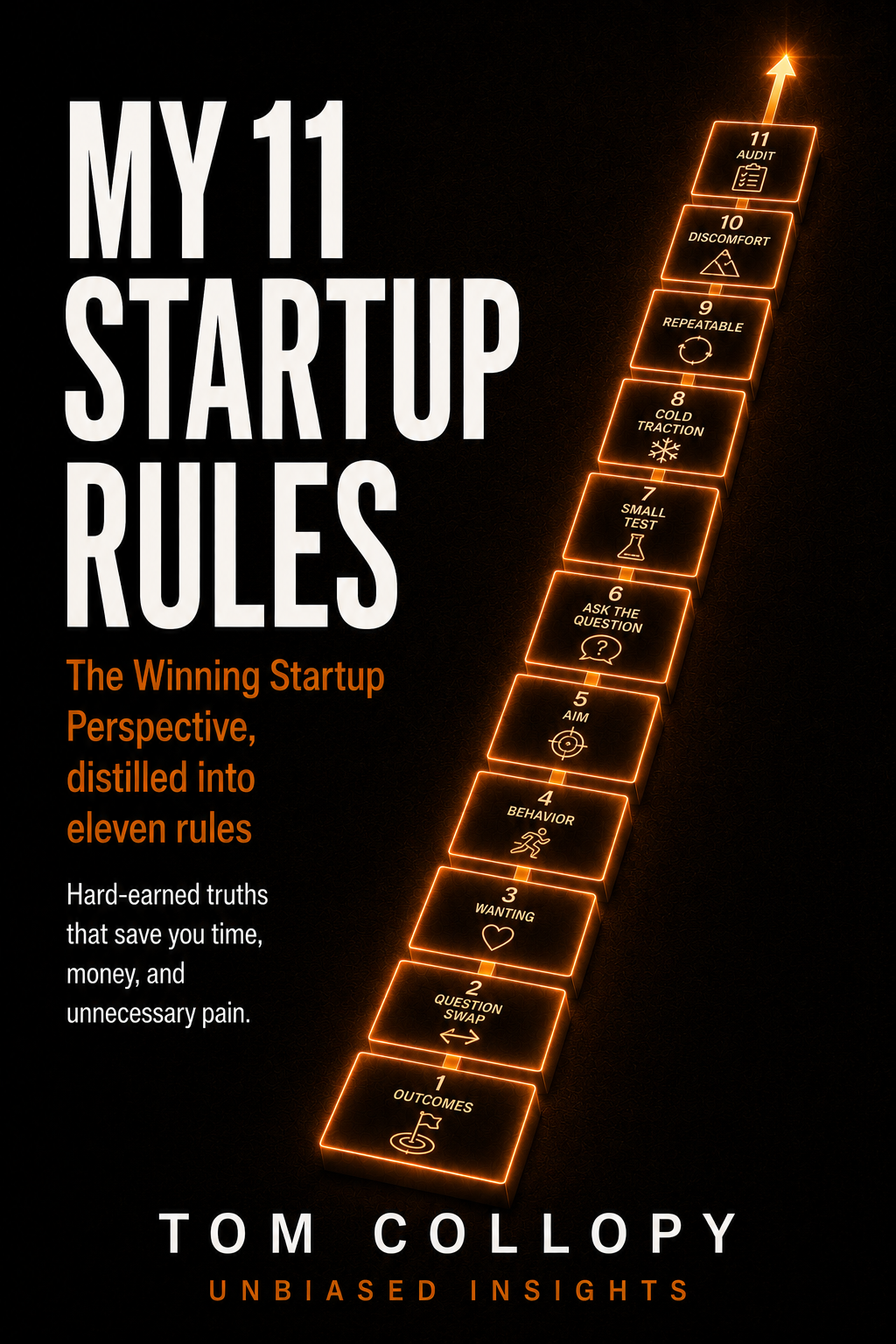
My 11 Startup Rules turns this into eleven rules for the day-to-day, each with the idea it rests on and a true story of it in the wild.

Visit site ↗
TC

Tom Collopy

Unbiased Insights

Tom Collopy has interacted with over a hundred early-stage founders across six Research Triangle accelerator programs: CED GRO, Launch Chapel Hill, RIOT, NC IDEA MICRO, Wake Forest Founders, and Andrews Launch Accelerator.

He has also advised more than 50 early-to-seed-stage startup founders directly, meeting with them weekly for months, sometimes years, through exit or shutdown.

The founders in this book, Marisol, Dev, Renu, and others, are composites built from that weekly advising work. None of them is one real person. All of them are true.

His work centers on one observation: most founders are running a sensible process from a perspective they never knew they had, solution-first. This book is what that same process looks like from the other side: outcome-first.

Visit Selling Outcomes ↗